




The scansion of the analytic session can sometimes give the analysand, especially in the early stages, the impression that he or she did not have time to say it all. The psychopathology of the couch is thus often punctuated by expressions of regret and frustration at having presented the analyst with an incomplete picture, which, in their mind, could hinder the analyst’s proper understanding by giving them a truncated view of their affairs. The ideal of exhaustiveness at issue here pays no heed to the structural impossibility highlighted by Lacan in Télévision when he objected to the notion of all of the truth as well as of saying. The introduction of the variable-length session, the interruption in the middle of a sentence, or even of a word whose equivocation then resonates, stand in opposition to the all, revealing it for what it is: at worst, vanity; at best, an illusion.
But exhaustiveness is not the only guise the ideal of saying it all takes on. Sometimes, the all hinges on a very particular element, and “I haven’t said it all” means that the analysand has, in fact, said nothing. That, for the moment, they have kept that fragment of truth to themselves. Between outpouring and withholding, the logic of saying it all unfolds in its nuances and also marks a mode of jouissance: sometimes One Thousand and One Nights (in the vein of “to be continued in the next episode”), sometimes Murder on the Orient Express (in the vein of “not giving anything away”).
Between elusive totality and masked unity, in contrast to that enchanted version of speech that presumes to be full yet expresses only void, Georges Perec’s approach takes shape. Here, too, one can speak of elusive totality and masked unity, but in their disenchanted form, stripped of the enveloping warmth that grows from mystery to revelation. This dual dimension (totality/unity) is expressed in his work through the attempt to exhaust meaning through description, notably in L’infra-ordinaire and Attempt to Exhaust a Place in Paris on the one hand, and, on the other, in A Void, a novel entirely conceived around the elision of the letter “e”—an elision that has been the subject of much discussion.
It is, among other works, in Attempt to Exhaust a Place in Paris that this particular quest for exhaustiveness finds expression, a quest that aims not to describe what is already known, cataloged, photographed, painted, and thus immortalized about a specific place (Place Saint-Sulpice), but rather the unnoticed ephemeral, the invisible aspects of everyday life: pigeons, buses, passersby… Coming several days in a row, standing in the same spot, and describing what is “not noticed, that which has no importance: what happens when nothing happens other than time, people, cars, and clouds.”[1] This approach is explained in the short book titled L’infra-ordinaire, in which Perec invites readers to pay attention to the “background noise”: “Take inventory of your pockets and your bag. Ask yourself about the origin, use, and fate of each object you remove from them. Question your teaspoons. What’s under your wallpaper? How many gestures does it take to dial a phone number? Why?” Perec’s proposal is based on an observation: newspapers, sensationalist news stories, and headlines teach him nothing. And he concludes: “It matters little to me that these questions are, here, fragmentary, barely indicative of a method, at most of a project. It matters a great deal to me that they seem trivial and futile: that is precisely what makes them just as—if not more—essential than so many others through which we have vainly attempted to grasp our truth.”[2]
The vain capture of truth feeds on a fallacious hierarchy, one that believes it can determine what is important, crafting a showcase for it while, in the order of discourse, saving the best for last, or concealing it. The path of the futile, the trivial, and that which becomes residue, escaping both the eye and the word, is, for Perec, what can, on the contrary, become a vehicle for a truth. A truth that cannot be captured but resides in “what seems to have ceased to astonish us forever”[3] and which, if we pay attention to it, may reveal to us at least one thing: that, blind to our surroundings and indifferent to the supposedly insignificant, “we sleep through our lives in a sleep without dreams.”[4] The inventory of the infra-ordinary, in its very monotony, consisting, for example, of the description of every house number on Rue Vilin, or of everything Perec ate and drank in 1974,[5] reveals to us the power of what structures the narrative: the blind spot.
[1] Perec, G., An Attempt at Exhausting a Place in Paris, trans. M. Lowenthal (Cambridge MA: Wakefield Press, 2010).
[2] Perec, G., L’infra-ordinaire (Paris: Seuil, 1989), p. 13.
[3] Ibid., p. 12.
[4] Ibid., p. 11.
[5] Ibid., p. 15 for Vilin Street and, on p. 97, the list of liquids and solids ingested.
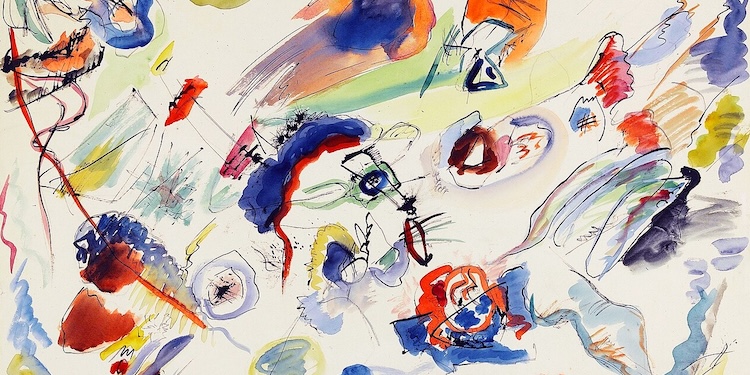
Vassily Kandinsky, Sans titre (Première aquarelle abstraite), 1910
