



In the Seminar Crucial Problems for Psychoanalysis, on the occasion of a reference to Plato’s Cratylus on the correctness of names, Lacan substitutes, for a teaching that would aim at the truth about truth [le vrai sur le vrai]—the final word of the matter, the last word—a continuous conversation, a form of debate that Plato’s dialogues perfectly illustrate. If there is no last word, it is most likely because, in matters of human affairs, it is not the word that operates but the signifier. This reference to the Cratylus also bears witness to the type of questionings that could exist then about what speaking means.
A Protocolized Speech
Our own civilization, for its part, is interested in the sign, and, since the advent of cybernetics especially, in information and communication: non-violent, of course! [sic] What this theory aims at—thereby joining the old psychological subject of knowledge—would be an adequacy between each point of the world with all the other points. [1]
In short, making One.
To this, Lacan opposes the fact that, with the signifier, we can make something else of the subject, “something determinable, localizable, whose metabolism can be grasped,” [2] but not without the indeterminable of equivocation.
Speech itself does not escape this empire of the sign, protocolized to the bone by psychology in order to achieve what is expected in terms of: trauma, mourning and any other life situation of which you will be a victim. This is the spoken subject.
The Child and Language [langue]
Saying that the analytic experience is an experience of speech is therefore not enough, any more than wanting to free this speech. For analysis is an experience of speech in which the word is lacking: in this place, it is the signifier that operates in its power of equivocation.
We all know Lacan’s interest in the moment when the child realizes that adults do not, after all, know everything about his or her thoughts. But this pass to take in language [langage] is not one of the simplest, and giving it careful consideration would shed light on many childhood situations that are too hastily qualified as opposition, as refusal, which can go as far as anger.
We would benefit from noting that the child is on the one hand like a “chatterbox” [3] [moulin à parole], and on the other hand he or she comes up against a wall: not that of the parents, but first and foremost of language [langage], made of words, which makes an enunciation difficult. Having so much ease as a chatterbox and so little margin with regard to this wall plastered with the meanings of the Other puts the child through a test because “for a subject to hide himself qua subject requires a form of sleight of hand that is rather trickier than many others I am led to present to you here.” [4]
The child who learns to handle language [la langue] takes pleasure in nonsense. This is what Freud made explicit in his work on jokes, where he evoked the relationship of human beings with nonsense, whether it is stifled or liberated. He specified then that “little by little [the child] is forbidden this enjoyment, till all that remains permitted to him are significant combinations of words.” [5]
This takes place, at the very least, at school, which is another pass to take.
The Chatter Bath
Language [langage] is encountered with the body. It took Freud to hear it. Lacan wondered, “How could people fail to appreciate before Freud that these people called men, or women on occasion, inhabit [chatter]? […] it is in the encounter between these words and [one’s] body that something takes shape.” [6]
But what does? What is misunderstood is that speech touches, and that something takes shape: the intention of the Other. The that one say [qu’on dise] of the intention is forgotten when “the sign is immediately grasped as intentional.” [7] Human beings are thus made: they have a sensitivity to this, and equivocation is the condition for it.
A knotting between language [langue] and symptom occurs then. “The fact that a child says, perhaps, not yet, before he is able to construct a sentence properly, proves that there is something in him through which everything is sieved, whereby the water of language [langage] happens to leave something behind as it passes, some detritus which he will play with, indeed which he will be forced to cope with.” [8] The water of language [langage] does not only create meanings, but also traces, furrows.
Where does the water come from? “It is absolutely certain that it is in the way in which language [langue] has been spoken and also heard as such, in its particularity, that something will subsequently emerge in dreams, in all sorts of mistakes, in all manners of speaking.” [9] which will have to be coped with, another pass to take.
And how? By constantly piercing the wall of language [langage], where speech may be brick, to drill an enunciation through it.
[1] Lacan J., Le Séminaire, livre xii, Problèmes cruciaux pour la psychanalyse, ed. J.-A. Miller (Paris: Seuil & Le Champ freudien, 2025), 245.
[2] Ibid., 246.
[3] Lacan, J., Desire and Its Interpretation: The Seminar of Jacques Lacan, Book vi, ed. J.-A. Miller, trans. B. Fink (Cambridge: Polity, 2019), 13.
[4] Ibid., 77.
[5] Freud S., Jokes and Their Relation to the Unconscious, se, Vol. 8, 125.
[6] Lacan J., “Geneva Lecture on the Symptom,” trans. R. Grigg, Analysis, no. 1 (1989), 13.
[7] Ibid., 20.
[8] Ibid., 16.
[9] Ibid., 14.
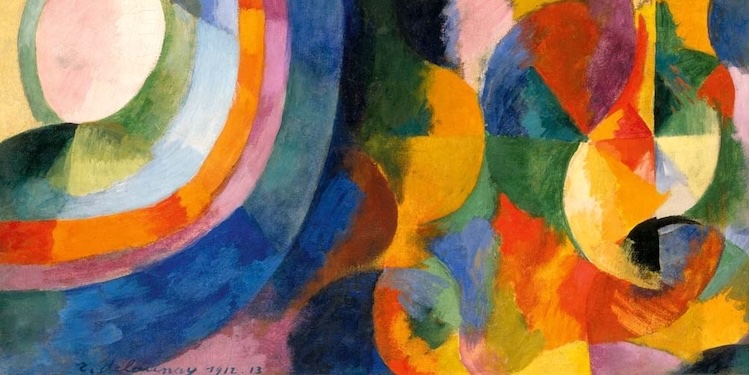
Robert Delaunay, Soleil, Lune, Simultané 1, 1913
